Businesses have spent years automating repetitive tasks through workflows. A form submission creates a lead, an approval triggers an email, or a payment updates an invoice. While these rule-based automations save time, they still depend on predefined logic and struggle when decisions require context or human-like understanding.
AI Action Nodes represent the next evolution of business automation.
Instead of simply executing a fixed sequence of actions, AI Action Nodes bring intelligence into workflows. They can analyze data, understand natural language, generate content, make recommendations, and adapt actions based on the context of each situation.
The result is a workflow that doesn't just automate—it thinks.
What Are AI Action Nodes?
An AI Action Node is an intelligent step within a workflow that uses artificial intelligence to perform tasks requiring reasoning, language understanding, or decision support.
Unlike traditional workflow nodes that follow strict "if-this-then-that" rules, AI Action Nodes evaluate the information available and generate dynamic outputs before passing the workflow to the next step.
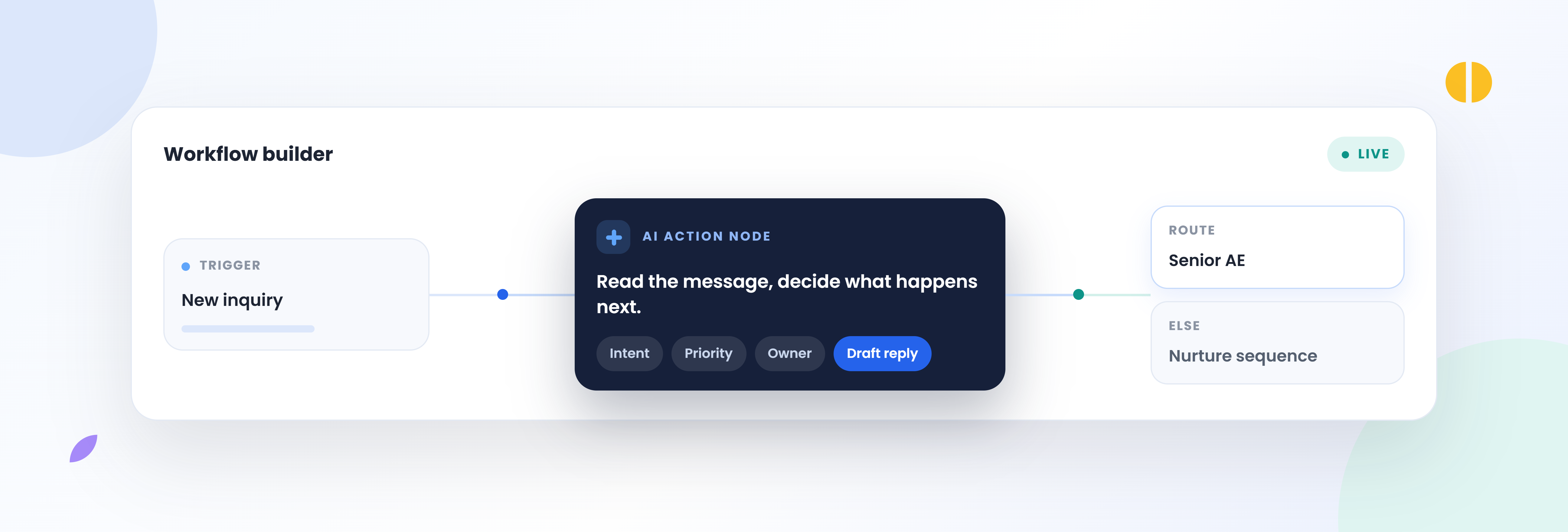
For example, instead of simply sending every new inquiry to the sales team, an AI Action Node can:
- Analyze the customer's message
- Determine their intent
- Classify urgency
- Extract important details
- Recommend the appropriate sales representative
- Generate a personalized response
All within a single workflow step.
Why Traditional Workflows Have Limitations
Rule-based workflows work well for structured processes, but businesses often deal with unstructured information such as emails, documents, conversations, customer requests, and support tickets.
Traditional automation cannot easily answer questions like:
- Is this customer likely to convert?
- Is this complaint urgent?
- Does this contract require legal review?
- Which department should handle this request?
- What should our response say?
Without AI, these decisions usually require manual intervention.
How AI Action Nodes Work
An AI Action Node receives information from previous workflow steps and uses AI models to analyze, generate, classify, summarize, or decide what should happen next.
Typical workflow:
- A trigger starts the workflow.
- Customer or business data is collected.
- The AI Action Node analyzes the context.
- AI produces structured results.
- The workflow continues based on AI-generated outputs.
Instead of creating dozens of complicated conditions, businesses can let AI interpret the situation and guide the workflow intelligently.
Practical Business Use Cases
Intelligent Lead Qualification
When a prospect submits a contact form, AI can evaluate:
- company size
- Industry
- Purchase intent
- Budget indicators
- Product interest
The workflow can automatically assign high-value opportunities to senior sales representatives while nurturing lower-priority leads.
Automated Customer Support
Incoming support requests often vary significantly.
AI Action Nodes can:
- Detect customer intent
- Categorize issues
- Determine urgency
- Suggest knowledge base articles
- Route tickets to the correct team
This reduces response times while improving customer satisfaction.
AI-Powered Email Generation
Instead of using generic templates, workflows can automatically generate personalized emails based on:
- Customer profile
- Previous conversations
- Sales stage
- Business context
Each communication feels relevant without requiring manual effort.
Document Processing
Businesses receive invoices, agreements, purchase orders, resumes, and forms every day.
AI can:
- Extract key information
- Summarize documents
- Validate fields
- Flag missing information
- Trigger approval workflows
Manual data entry becomes largely unnecessary.
Smart Approval Workflows
Traditional approval chains treat every request equally.
AI Action Nodes can analyze requests before they reach decision-makers by:
- Identifying risk
- Estimating business impact
- Highlighting unusual requests
- Providing concise summaries
- Recommending approval or review
Managers spend less time reviewing routine requests and more time on strategic decisions.
Benefits of AI Action Nodes
Organizations adopting intelligent workflows gain several advantages:
- Faster decision-making
- Reduced manual effort
- Higher workflow accuracy
- Improved customer experiences
- Better resource allocation
- More personalized automation
- Greater operational efficiency
- Easier scaling without increasing administrative workload
Rather than replacing employees, AI enables teams to focus on higher-value work.
Best Practices for Building Intelligent Workflows
Successful AI workflows combine automation with human oversight.
Keep these principles in mind:
Start with High-Impact Processes
Begin by identifying repetitive workflows that consume significant time or involve large volumes of data.
Examples include:
- Sales qualification
- Customer support
- HR onboarding
- Invoice processing
- Internal approvals
Keep Humans in the Loop
AI should assist decision-making—not always replace it.
For high-risk actions such as financial approvals or legal decisions, include human review before final execution.
Use Structured Outputs
Configure AI Action Nodes to return consistent outputs such as:
- Intent
- Sentiment
- Priority
- Confidence score
- Category
- Recommended action
Structured data makes downstream automation more reliable.
Continuously Improve
Monitor workflow performance, review AI recommendations, and refine prompts or business rules over time.
The most effective intelligent workflows evolve alongside your business.
The Future of Workflow Automation
Business automation is moving beyond simple task execution.
The next generation of workflows will understand conversations, interpret documents, predict outcomes, generate content, coordinate across departments, and continuously optimize themselves using AI.
Organizations that embrace intelligent workflows today will be better prepared to handle increasing operational complexity while delivering faster, smarter, and more personalized experiences.
How Worxley AI Enables Intelligent Workflows
Worxley AI combines powerful workflow automation with AI Action Nodes, allowing businesses to build processes that adapt to real-world situations.
Whether you're automating sales, customer support, HR, operations, or internal approvals, AI Action Nodes can analyze information, generate intelligent responses, classify requests, summarize data, and guide workflows with contextual decision-making.
Instead of building hundreds of rigid workflow rules, your teams can create flexible, intelligent automations that scale with your business.
Final Thoughts
Traditional workflows automate actions. Intelligent workflows automate decisions.
By embedding AI Action Nodes into everyday business processes, organizations can eliminate repetitive manual work, improve accuracy, accelerate response times, and empower teams with real-time intelligence.
As AI continues to evolve, intelligent workflows will become a fundamental part of how modern businesses operate—and organizations that adopt them early will gain a lasting competitive advantage.