Customer operations, explained.
Customer operations is the practice of running every customer-facing process — capture, sales, quotations, payments, and service — as one connected system instead of a chain of disconnected tools. A CRM records what happened. A customer operations platform runs the work.
A system of action, not just a system of record
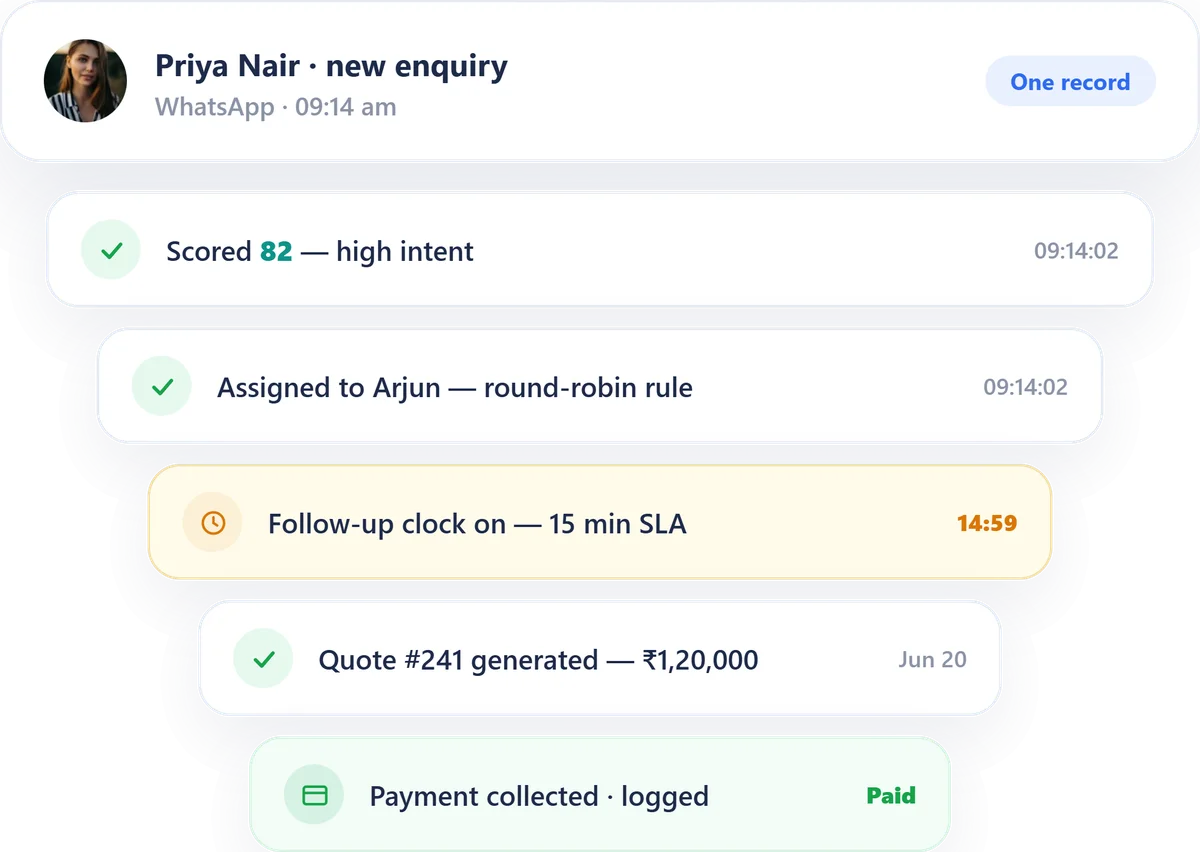
Most software sold as CRM is a system of record. It stores contacts, deals, and a history of what your team did. That is useful, but it is passive: the record only reflects reality if somebody remembers to update it, and it does nothing when they forget.
Customer operations treats the same information as a system of action. The lead is not just stored, it is scored, routed, and put on a clock. The quotation is not a document somebody types up elsewhere, it is generated from the deal itself. The payment is not reconciled next month, it is collected against the record now. The distinction sounds academic until you count how many times a day your team moves the same customer's details from one tool into another.
Calling it CRM invites a comparison of contact-management features. Calling it customer operations asks a better question: how much of the work between an enquiry arriving and money landing does the software actually do?
Fragmentation is easy to live with and expensive to keep
Teams rarely decide to run fragmented operations. It accumulates — a tool added here, a spreadsheet there — until the seams cost more than the tools.
A CRM for the pipeline, a document tool for quotes, an accounting tool for invoices, and WhatsApp for the actual conversation. Every boundary between them is a manual copy and a chance to drop the thread.
If your team types a customer's name and number more than once — once into the CRM, again into the invoice — you are paying for the same data twice and guaranteeing the two copies will eventually disagree.
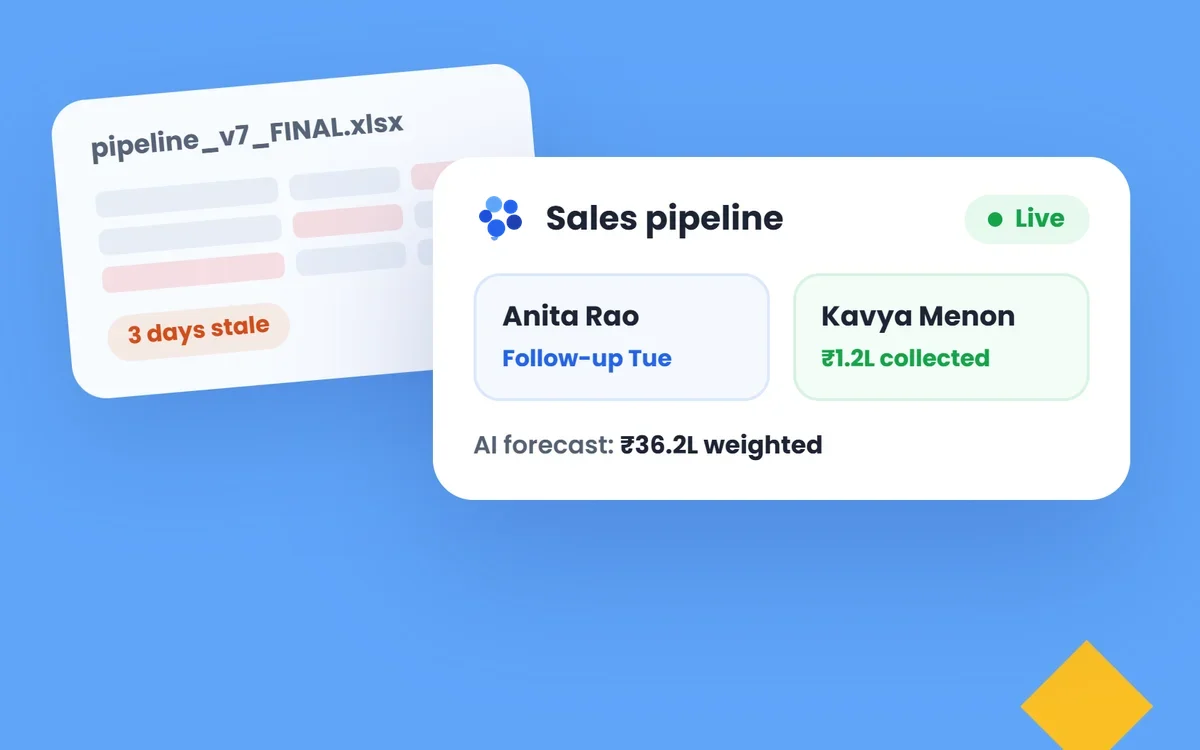
When the pipeline lives in one system and the money lives in another, nobody can say what actually closed without a manual reconciliation. The forecast and the bank statement tell different stories.

What customer operations actually covers
Four stages, one record. If any stage lives in a different system, the handoff between them becomes manual work somebody has to remember.
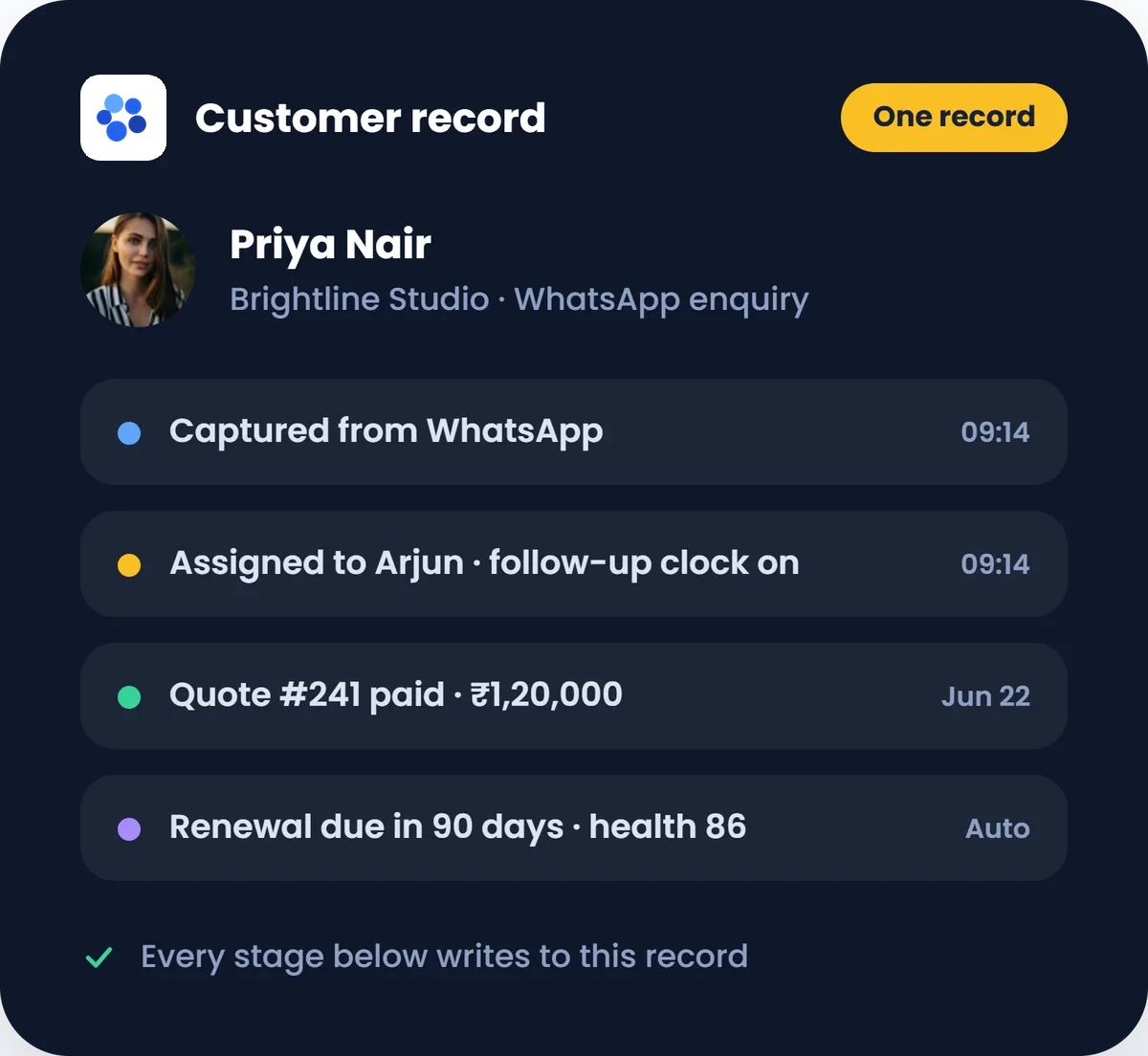
Capture
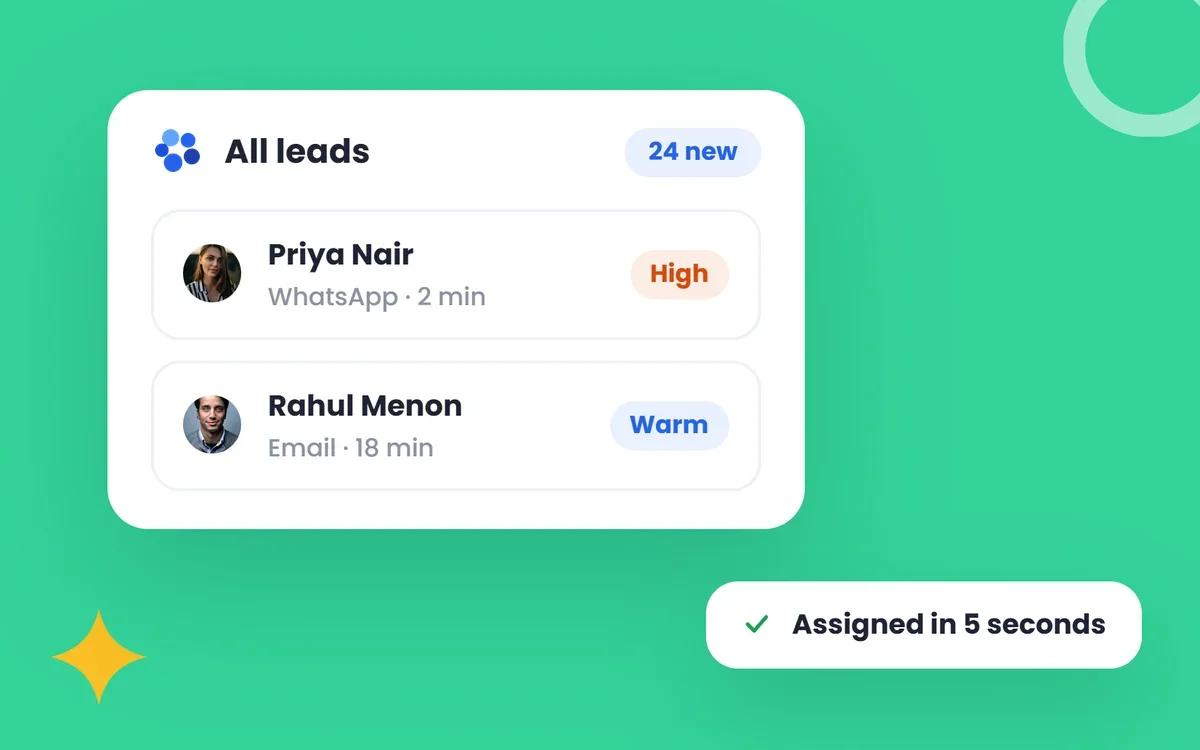
Every enquiry arrives in one place, tagged with where it came from. Website forms, WhatsApp, Facebook, email, phone calls, walk-ins, and referral partners all land in the same pipeline instead of four different inboxes.
Route and act
The lead is scored, assigned by rule rather than by whoever checks first, and given a follow-up clock. When that clock runs out, the system escalates on its own — nobody has to remember.
Transact
Quotations and invoices are generated from the same record the salesperson has been working, and payment is collected through a connected gateway. No re-keying figures into a separate accounting tool.
Retain and report
Post-sale conversations, renewals, and support history attach to the same customer record. Reporting draws from one dataset, so the pipeline number and the revenue number finally agree.
Traditional CRM vs customer operations
| DIMENSION | TRADITIONAL CRM | CUSTOMER OPERATIONS |
|---|---|---|
| Primary purpose | Record what happened | Run the work as it happens |
| Lead follow-up | A field you update manually | An SLA the system enforces and escalates |
| Quotations | Usually a separate document tool | Generated from the live deal record |
| Payments | Tracked elsewhere, reconciled later | Collected in-flow, logged automatically |
| Conversations | Logged after the fact, if remembered | Captured from the channel itself |
| Reporting | Sales activity only | Lead through cash, one dataset |
| Failure mode | Data goes stale and trust erodes | Process gaps surface as alerts |
This is a difference of scope, not of quality. A good CRM is a necessary part of customer operations — it is simply not the whole of it.
Moving in the right order
The sequence matters more than the speed. Each step makes the next one safe.
Consolidate capture first
Get every lead source flowing into one pipeline with its origin tagged. You cannot fix a follow-up problem you cannot see.
Make follow-up a rule, not a habit
Assign by strategy, put a clock on first response, and let the system escalate when the clock expires.
Pull quotations and payments inward
Generate the quotation from the deal record and collect payment against it — pipeline and revenue finally agree.
Report from one record, then automate
Once capture, follow-up, and payment share a record, reporting is trustworthy — only then layer automation on.

Customer operations, answered
Customer operations is the practice of running every customer-facing process — lead capture, sales, quotations, payments, and post-sale service — as one connected system rather than as separate tools owned by separate teams. Where a traditional CRM records what happened, a customer operations platform runs the work itself.
A CRM is a system of record: it stores contacts, deals, and activity history. Customer operations is a system of action: it also executes the workflow — routing the lead, enforcing the follow-up SLA, generating the quotation, collecting the payment, and updating the record automatically. CRM is a component of customer operations, not a synonym for it.
Because the cost of fragmentation scales faster than headcount. With a CRM for sales, a separate invoicing tool, a separate payments gateway, and WhatsApp for conversations, every handoff is a manual copy-paste and a place where deals stall. Consolidating those into one operational system removes the handoffs rather than just documenting them.
No. Smaller teams usually feel fragmentation sooner, because the same person often handles the lead, the quotation, and the follow-up. A ten-person business switching between four tools loses proportionally more time than a hundred-person business with dedicated roles for each step.
At minimum: multi-channel lead capture, a configurable pipeline with automated assignment and SLA enforcement, quotation and invoice generation, integrated payment collection, and a single customer record that every one of those steps writes back to. Reporting and AI assistance sit on top of that shared record.
Most teams start within a day by importing existing contacts and deals, then configure pipelines and automations over the following week. The migration is usually gradual — teams typically move lead management first, then quotations and payments once the pipeline is running.
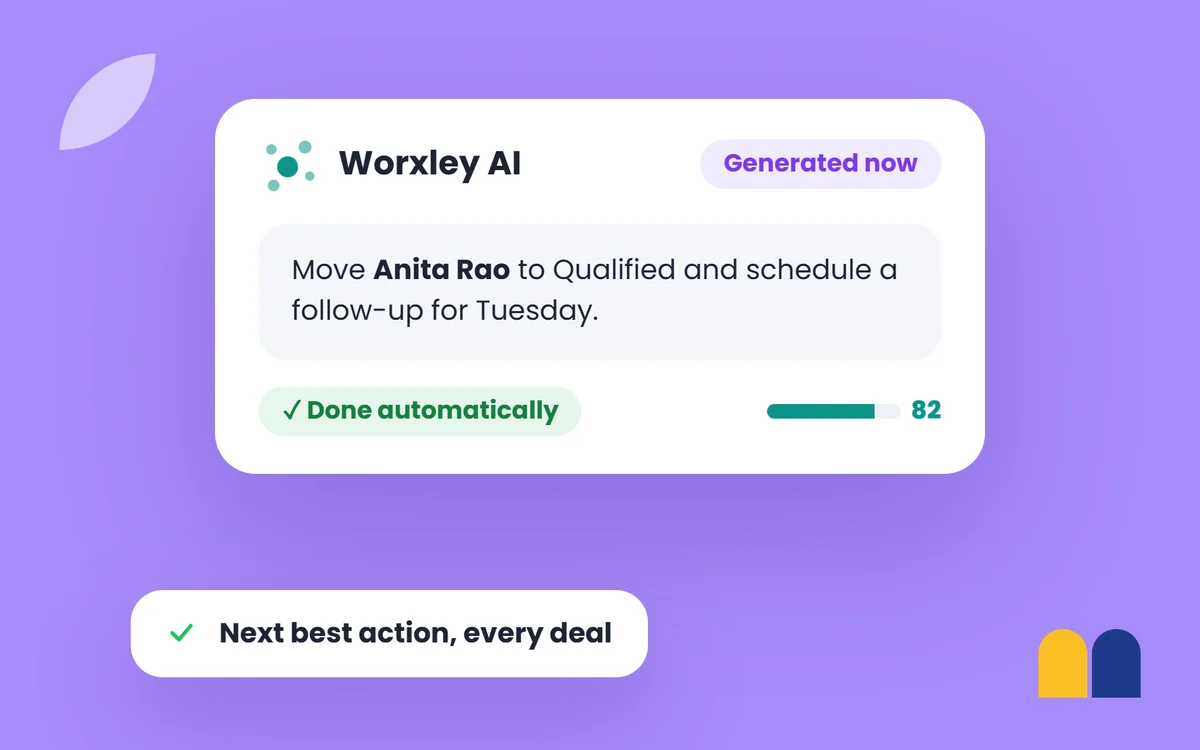
No. Automation handles the mechanical parts — routing, reminders, data entry, document generation — so salespeople spend their time on the conversations. AI assists by scoring leads and drafting follow-ups, but the decisions and the relationship stay with your team.
You've seen what customer operations looks like. Now run yours in one place.
Bring capture, sales, quotes, payments and service onto one record — one stage at a time.