Artificial intelligence is rapidly transforming Customer Relationship Management (CRM), helping businesses automate repetitive tasks, qualify leads, generate personalized content, and provide intelligent recommendations. As AI becomes deeply integrated into daily business operations, organizations must also ensure that it operates securely, responsibly, and transparently.
This is where enterprise AI governance becomes essential.
Enterprise governance provides the policies, controls, and safeguards that ensure AI systems remain trustworthy while protecting customer data, maintaining compliance, and supporting responsible decision-making. Without proper governance, even the most powerful AI capabilities can introduce unnecessary risks.
Why AI Governance Matters
Modern CRM platforms handle some of an organization's most valuable information, including customer details, business conversations, contracts, financial records, sales opportunities, and support history.
When AI has access to this information, businesses need confidence that it:
- Uses data responsibly
- Protects sensitive information
- Produces reliable responses
- Follows organizational policies
- Maintains auditability
- Respects user permissions
Enterprise governance ensures AI enhances productivity without compromising security or trust.
Common Risks Without AI Governance
Organizations adopting AI without proper oversight may encounter challenges such as:
- Unauthorized access to confidential customer information
- AI-generated responses containing inaccurate information
- Exposure of sensitive business data
- Inconsistent outputs across departments
- Poor compliance with industry regulations
- Limited visibility into AI-generated decisions
- Difficulty investigating unexpected AI behavior
These risks can affect customer trust, operational efficiency, and regulatory compliance.
Core Principles of Trustworthy CRM AI
Role-Based Access Control
AI should only access information that a user is already authorized to view.
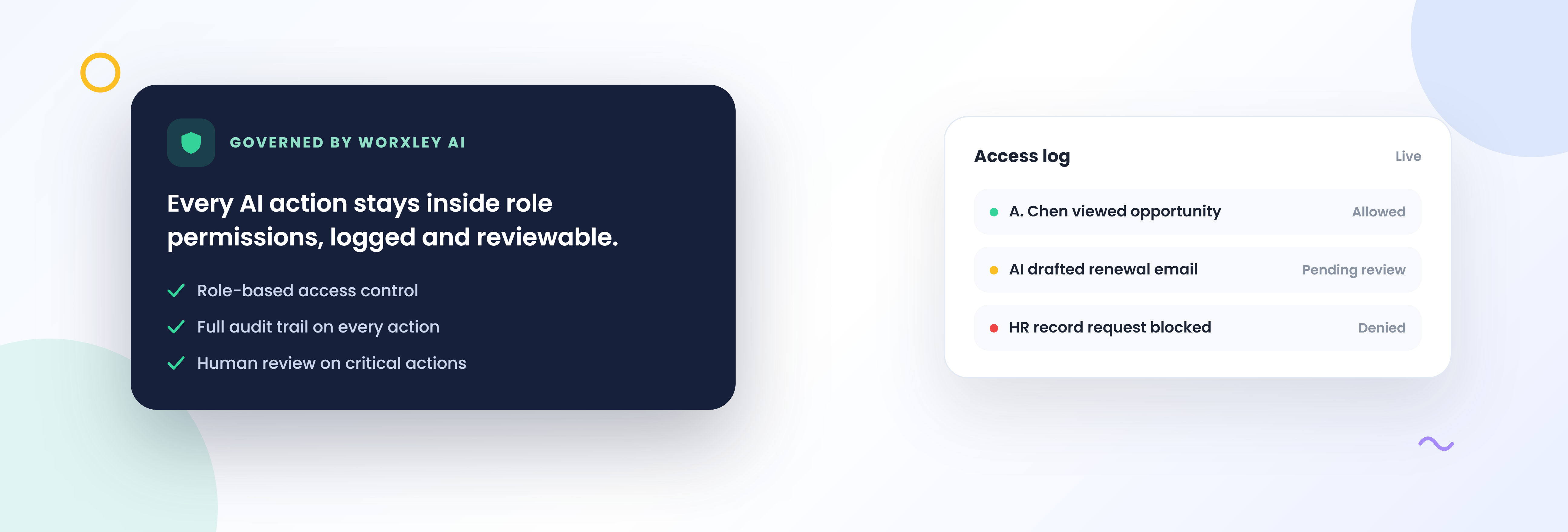
A sales representative should not receive HR records, while a finance user should only access financial information relevant to their responsibilities.
Role-based permissions ensure AI respects the same security boundaries as the CRM itself.
Data Privacy by Design
Customer privacy should never be an afterthought.
Organizations should implement practices such as:
- Data encryption
- Secure API communication
- Data masking
- Access logging
- Limited data retention
- Secure backups
Protecting customer information is fundamental to responsible AI adoption.
Human Oversight
AI is designed to assist—not replace—business professionals.
Critical business actions such as pricing approvals, contract acceptance, financial transactions, or policy changes should include human review before execution.
Maintaining human oversight helps reduce errors while increasing accountability.
Transparency
Users should understand when AI is assisting them.
AI-generated summaries, recommendations, or responses should be clearly distinguishable from manually created content.
Transparency builds confidence while allowing employees to validate AI recommendations before acting on them.
Audit Trails
Every important AI interaction should be traceable.
Organizations should maintain logs showing:
- Who initiated the request
- Which AI service responded
- When the interaction occurred
- What actions were recommended
- Whether the recommendation was accepted
Audit trails improve accountability and simplify investigations when necessary.
Governance Across the CRM Lifecycle
Enterprise governance should extend across every stage of customer engagement.
Sales
AI can recommend next actions, prioritize opportunities, and generate personalized emails while ensuring sensitive pricing strategies and confidential customer information remain protected.
Customer Support
AI assistants can summarize conversations, classify tickets, and suggest responses while respecting customer privacy and internal support policies.
Marketing
AI-generated campaigns should follow brand guidelines, approved messaging, and consent requirements to maintain consistency and regulatory compliance.
Operations
Internal workflow automation should follow approval processes and organizational policies before triggering high-impact business actions.
Governance ensures every department benefits from AI while maintaining consistent standards.
Responsible AI Best Practices
Organizations building AI-powered CRM platforms should adopt several best practices:
- Enforce role-based permissions across AI services
- Validate AI outputs before executing critical actions
- Encrypt sensitive customer information
- Maintain detailed activity logs
- Define clear approval workflows
- Regularly review AI performance
- Continuously update governance policies
- Educate employees on responsible AI usage
Responsible AI is not a one-time implementation—it is an ongoing operational practice.
Building Customer Trust
Customers increasingly want to know how their information is collected, processed, and protected.
Organizations that demonstrate responsible AI practices gain several advantages:
- Greater customer confidence
- Stronger regulatory compliance
- Reduced operational risk
- Improved data quality
- Higher employee confidence in AI recommendations
- Better long-term adoption of AI across the organization
Trust becomes a competitive advantage.
The Future of Enterprise AI Governance
As AI capabilities continue to evolve, governance frameworks will become increasingly important.
Future CRM platforms will include:
- Explainable AI recommendations
- Automated policy enforcement
- Continuous compliance monitoring
- Intelligent risk detection
- Fine-grained permission controls
- Organization-wide AI governance dashboards
Businesses that invest in governance today will be better prepared to scale AI safely tomorrow.
How Worxley AI Prioritizes Trust
At Worxley AI, we believe powerful AI should also be responsible AI.
Our platform is designed with enterprise governance in mind, combining intelligent CRM capabilities with robust security controls, permission-aware AI, workflow approvals, auditability, and responsible automation practices. This enables organizations to confidently adopt AI while maintaining compliance, protecting customer information, and preserving trust across every interaction.
Final Thoughts
Artificial intelligence delivers its greatest value when businesses can trust it.
Enterprise AI governance provides the foundation for secure, transparent, and responsible CRM automation. By combining intelligent capabilities with strong security, privacy, and oversight, organizations can confidently embrace AI while protecting the people and data that matter most.
The future of CRM isn't just intelligent—it's trustworthy.