Electronic signatures have become the standard for modern business. Contracts can now be reviewed, approved, and signed in minutes instead of days, eliminating the need for printing, scanning, and physical paperwork.
But not every digital signature offers the same level of trust.
A simple checkbox or an uploaded image of a handwritten signature may indicate intent, but it doesn't provide the evidence needed to prove who signed the document, when it was signed, or whether it has been altered afterward.
That's where a comprehensive e-signature audit trail becomes essential.
What Is an E-Signature Audit Trail?
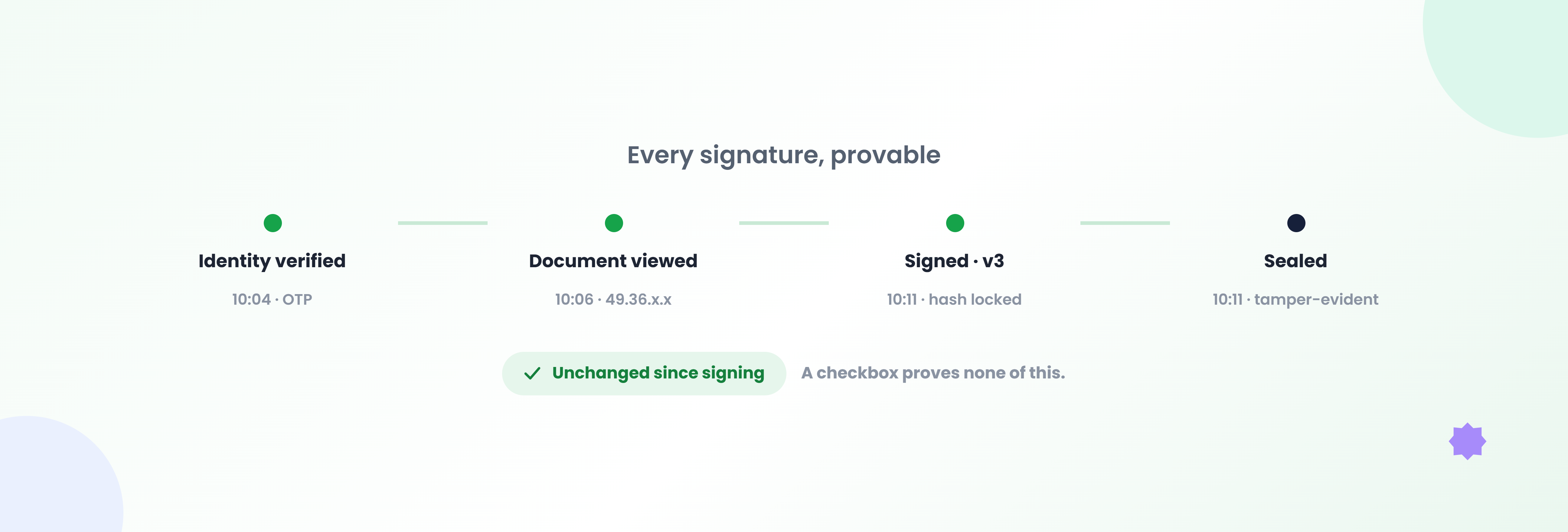
An audit trail is a chronological record of every action that occurs during the signing process.
It creates a transparent history of the document—from the moment it's created until every required party has signed it.
Rather than simply showing that a document was signed, an audit trail answers important questions such as:
- Who signed the document?
- When was it viewed?
- When was it signed?
- Which device was used?
- What IP address initiated the signing?
- Was the document modified after signing?
- Were all required approvals completed?
A complete audit trail transforms an electronic signature into verifiable evidence.
Why a Checkbox Isn't Enough
Many websites display a checkbox that says:
"I agree to the terms and conditions."
While useful for basic acknowledgements, this alone is rarely sufficient for important agreements.
A checkbox generally cannot prove:
- The identity of the signer
- Whether the document changed afterward
- The exact version that was accepted
- The sequence of signing events
- Whether all required parties completed the process
For business contracts, vendor agreements, employment documents, or financial approvals, stronger verification is essential.
What Every Audit Trail Should Include
1. Signer Identity
The audit trail should record who signed the document and how their identity was verified.
Depending on the platform, verification may include:
- Email verification
- OTP verification
- Identity authentication
- Organization login
- Multi-factor authentication
Knowing who signed is the foundation of trust.
2. Accurate Timestamps
Every significant action should include a precise timestamp, including:
- Document creation
- Invitation sent
- Document viewed
- Signature completed
- Final document generated
This creates a complete timeline of events.
3. IP Address and Device Information
Recording technical details helps strengthen evidence by documenting:
- IP address
- Browser
- Device type
- Operating system
- Geographic region (where applicable)
These details help demonstrate where and how the document was signed.
4. Document Version History
One of the most important aspects of an audit trail is proving that the signed document hasn't changed.
A secure e-signature system should record:
- Document version
- Revision history
- Final signed version
- Cryptographic document hash or integrity verification
This ensures the signed document remains tamper-evident.
5. Signing Sequence
Many contracts require multiple approvals.
The audit trail should clearly show:
- Who signed first
- Who signed next
- Pending signers
- Completed approvals
- Final completion status
This provides complete visibility into the approval workflow.
6. Tamper Detection
A trustworthy e-signature solution should immediately indicate if the signed document has been modified after completion.
Tamper detection typically relies on cryptographic verification that can identify even the smallest change made after signing.
This protects the integrity of the agreement.
Why Audit Trails Matter
A detailed audit trail benefits every stakeholder.
For Businesses
- Demonstrates compliance
- Reduces disputes
- Improves internal accountability
- Simplifies audits
- Accelerates approvals
For Customers
- Greater transparency
- Higher confidence
- Clear signing history
- Assurance that documents haven't been altered
Trust grows when every action is documented.
Common Mistakes Businesses Make
Many organizations unknowingly weaken their signing process by:
- Accepting scanned signatures without verification
- Sharing unsigned PDFs over email
- Failing to track document versions
- Storing signed files without audit logs
- Allowing unsigned edits after approval
- Using multiple disconnected approval systems
These practices make contracts harder to verify and manage.
Best Practices for Secure E-Signatures
To create a reliable signing process:
- Verify signer identity before signing.
- Generate immutable audit logs.
- Record timestamps automatically.
- Capture IP and device information.
- Lock documents after completion.
- Preserve version history.
- Enable tamper detection.
- Store signed documents securely.
A secure workflow protects both the organization and the signer.
The Future of Digital Agreements
As businesses continue moving toward paperless operations, audit trails will become even more important.
Modern digital agreement platforms are evolving to include:
- Identity verification
- Automated approval workflows
- Digital certificates
- Tamper-evident documents
- Compliance reporting
- Long-term document validation
The goal isn't simply to collect signatures—it's to establish trust throughout the entire approval process.
Final Thoughts
An electronic signature is only as trustworthy as the evidence behind it.
A checkbox or typed name may indicate agreement, but a complete audit trail proves who signed, when they signed, how the document was protected, and whether it remained unchanged after approval.
For organizations handling contracts, proposals, vendor agreements, or internal approvals, a robust audit trail isn't just a technical feature—it's the foundation of secure and defensible digital agreements.